


A while ago, I had to take my wife’s car in to the dealership for “unknown” problems. The issue was that it wouldn’t startup on a cold engine, randomly. The final diagnosis was the service department holy trinity: can’t replicate, can’t find, can’t solve.
¯\_(ツ)_/¯
Awesome, right? I actually did a little digging around on various forums prior to the car’s arrival at the dealership and discovered that if the coolant temperature sensor operates out of its expected range, the ECU will not cooperate either. Which, for whatever reason, the immobilizer will kick in instead of… umm… throwing a “check engine” indicator and going into baseline/safety/limp-home values table within the ECU/ECM so that anyone with a decent OBD2 scanner can see the issue at hand. Not going to name the brand, but – Found On the Road Dead – It really did live up to its stereotype, unfortunately.
While I was explaining to the service adviser what I found and “please have the service guys spend a few minutes of their time and physically check the temp sensors and not rely on a scanner since this is on my dime“, we were also discussing how cars were somewhat simpler to diag when everything wasn’t tied into one another system-wide just a generation ago. I mentioned to the adviser that I’m working on a ’73 Toyota Corona.
“You mean Corolla, right?”
“Nope, Corona. Like the beer,” I said.
“Bruh! I remember that car… I had one during college in the late ’70s,” the adviser said with pride. “It’s been a long time since I’ve seen one around here. Where did you find that?’

Quick Backstory
This particular car was an estate sale that made its way from Midland, TX to Houston. From the smells and caked mud-oil, it was literally out to pasture there. In that part of the state, it’s not as humid and rainy, but there is rust on the extremities of the body as well as Bondo filler done incorrectly. 2005 was the last time it was registered. The gas tank seemed like the fuel emulsified into a napalm-ready mixture with toxic fumes emanating. The dashboard… is covered in duct tape. At some point, possibly in the ’80s, someone decided to upgrade the stereo and add a subwoofer. It was a subwoofer from a home stereo system. Windows and their mechanisms were all shot. The headliner is amazingly in good condition, but the front bucket seats had shag covers on them. They were too in somewhat good condition, but its mechanisms as well are shot.

Corona, the first popular Toyota in America, was designed specifically for American drivers. With a powerful engine, factory-installed air conditioning and an automatic transmission, Corona helped increase U.S. sales of Toyota vehicles threefold in 1966 to more than 20,000 units.
“COMPANY HISTORY” – pressroom.toyota.com/company-history/
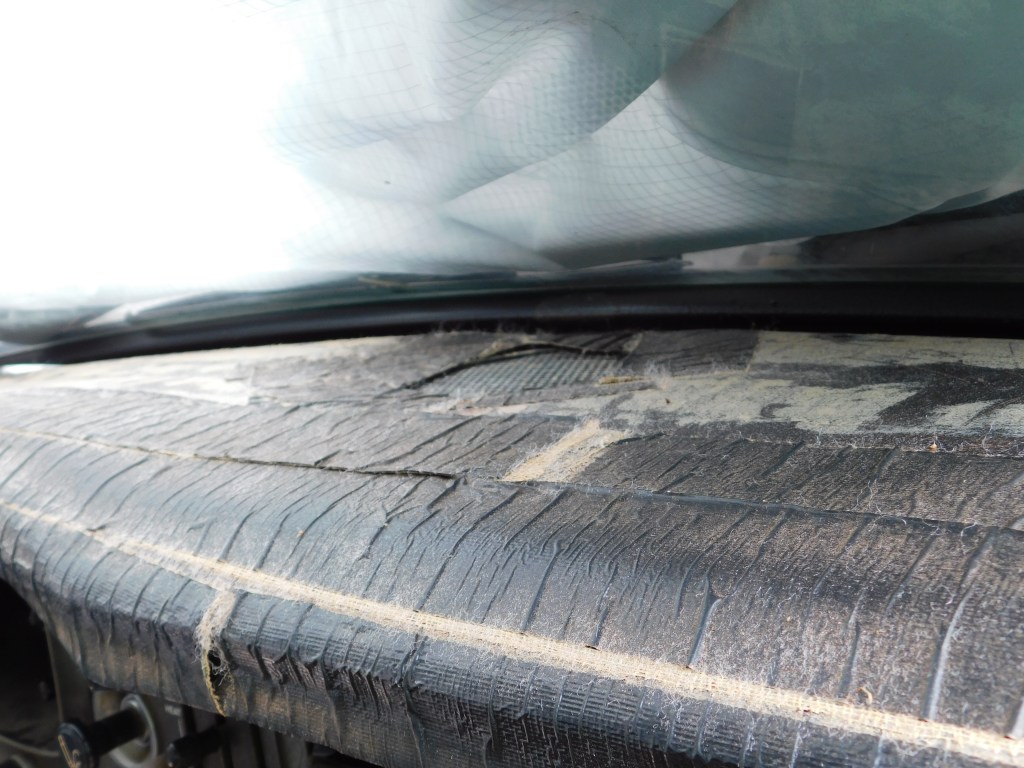
This was the car that popularized Toyota in the U.S. during the ’70s, yet these cars are increasingly hard to find.
The T-80 series Corona was introduced February 1970 and was a complete redesign, and was developed on a separate platform from the Toyota Corona Mark II, which became a larger, more comfortable and powerful car, where the Corona remained focused on fuel economy. Body styles were further reduced to a two door hardtop coupe, a four door sedan and station wagon. The engine continued to use a OHV on base level vehicles, and SOHC on the two door coupes, and the engines used in the Mark II were shared with the Corona… A performance oriented Corona sedan was introduced in 1970, called the Toyota Carina. The 2.0 liter engine appeared in the 2000SL and the 2000SR with fuel injection.
Mark II (T60/T70 series) – http://www.cars-directory.net/history/toyota/corona/
OE Specs
It’s not all that impressive for the powerplant, but it was originally tailored for compact comfort. For a car that weighs roughly 1 ton, I guess the numbers aren’t too bad (power ratio of roughly 20:1). The Mark II, Carina, and Celica were more performance-oriented in the line up at the time.

Okay… Why?
Why not? Emotionally, it looks and feels like a sporty, classic car. Mechanically, it shares “enough” with some 70’s and 80’s Toyotas. Originally, the power-plant is the single-cam, 2-liter 18RC along with a W40 tranny and D-series rear end. That basically means engine upgrades and components are difficult to come by or achieve within affordability. What would be just as awesome (and pricey with a splash of rarity) would be to squeeze in the dual overhead cam variant 18RG. I guess this is where the resto-mod comes in – naturally aspirated 7AGE engine swap with W58 tranny and LSD.
Build list goals:
- Custom 7AGE engine with individual throttle bodies and PNP cylinder head
- Upgraded suspension and drivetrain
- Custom bodywork
- Restored interior*
Hopefully, the car will be up to a power ratio of 10:1…
The last bullet is actually a little trickier than expected. Components that would actually be made for an RT9x/8x are almost impossible to find. So, the next best thing is to jump up to the RT1xx series. The earlier RT1xxx (’73-’74) wasn’t a drastic departure aesthetically and is still available. In the end, the car will not be a “true” RT95, but more of a blend of RT9X/1xx/AE/RA components. There are other subtle things that will be replaced, like electrical, brakes, and fuel lines because you would have to be insane to keep using those.
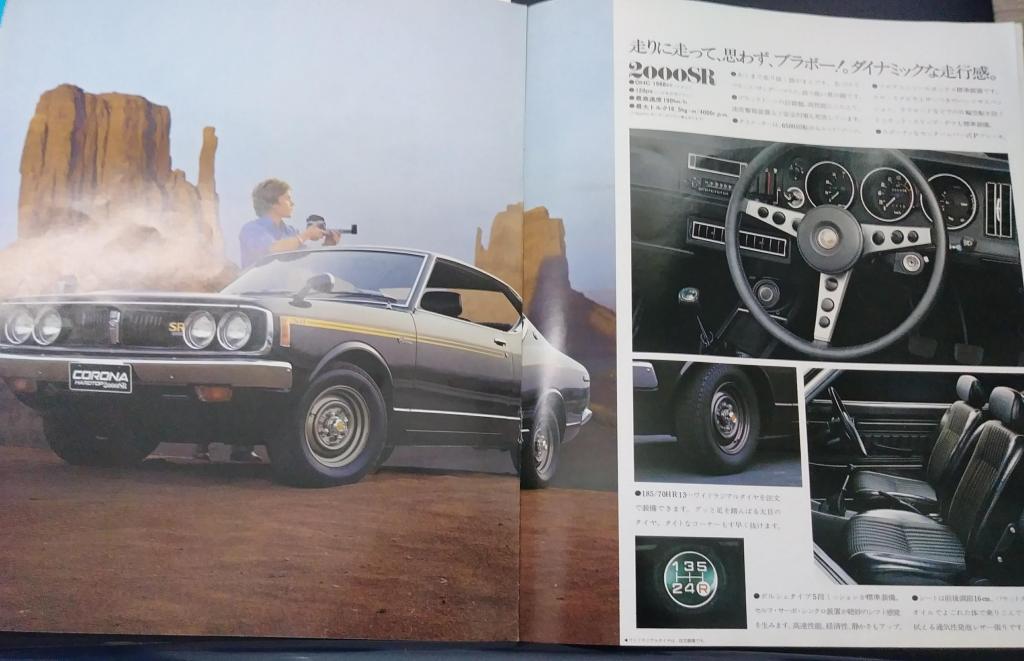

August 31, 1973 saw the introduction of the Corona T100-Series, which continued to be built as a 4-door sedan, 2-door hardtop coupe and 4-door station wagon. Engines were 1.6 and 2.0 liters SOHC. In North America, the 20-R 2.2 liter engine was used. The high performance 2000 GT Sedan and Hardtop Coupe with 18R-G twin cam engine were only offered in Japan… The face lift revised the hood and grille, and enlarged the tail lights… North American models had longer bumpers (hiding recoverable bumper shocks) to meet local 5mph (8.0km/h) impact standards… The two door hardtop continued, with trim levels 1600GL, 1800SR and the 2000SR, with the coupe proving popular in the USA, but proved to be more popular in Japan.
Mark II (T60/T70 series) – http://www.cars-directory.net/history/toyota/corona/
As mentioned in the previous post Update and Engine Choice, an overall build goal has been laid out and it’s just now gathering up all the right pieces and setting deadlines. BUT… I’m not going to do forced induction just yet. So, 7 to 1 will not happen. It will be fun to drive though.

References
- Toyoland – Corona
- Toyota History – Corona
- Cars Directory – History of the Corona
- Chilton’s Repair & Tune-Up Guide: Toyota Corona/Crown/Cressida/Mark II/Van 1970-86, Chilton Book Company, Radnor, PA, USA, 1987

 Banneker Motoring, Ltd.℠
You must be logged in to post a comment.