

CAN-bus Networking or the Lack Thereof
One of the few pet peeves of mine, in general, is bad salesmanship. In my search for the right tech, services, and parts I come across situations that could have been handled differently. And I’m not totally innocent in the conversation either. I do occasionally phish for details while not disclosing all info immediately.
One particular as of late has been with Controller Area Networks. At the most general level of understanding, it is a two-wire serial bus network somewhat similar to RS485 consisting of multiple ‘nodes’ or stations. At any given time, there are packets broadcasted onto the network. That packet ‘should’ consist of a start, an end, and information. Network standards are ‘somewhat’ dictated by the governing body in the Society of Automotive Engineers (SAE) and ISO 11898 – (TI’s explanation). When it comes to aftermarket, you have to wade through a lot of… well… BS to find out where you need to start at for compatibility with other systems.
For instance, I like to start the conversation with the manufacturer’s tech sales/support with very basic info to see if they are into building relationships or not. Unfortunately, most will become ‘bothered’ if you ask for more info on how their device works on a simplistic level. Hell, I have even asked an “up and coming” ECU manufacturer that set up shop here Texas on the nuts bolts of their CAN, like default node ADDR or does it adhere to SAE J1939/2534 or some other proprietary standard. Their response was as followed:
…All of the protocols you’ve mentioned are different. CAN is a complex subject and not something that can be covered in a single email.
Maybe they skimmed read my request? Maybe too tired to talk about how their system is superior to the competition? Maybe too tired to send that PDF that would explain their system in detail. All I took from that response is that my money is not worth their effort. I mention J1939 in my conversation(s) because there are tons of documentation on SAE’s website and I prefer to at least to talk the same language than just guessing, though it is a standard highly used with commercial/heavy vehicles AND everyone has a slight interpretation of the said standard.
Further, according to EEtimes.com in their article on how to implement CAN protocol in 3G wireless networks, they kindly mentioned that CAN was first developed in the late ’80s by Bosch. Later in the topic, Mr. Sanogo writes:
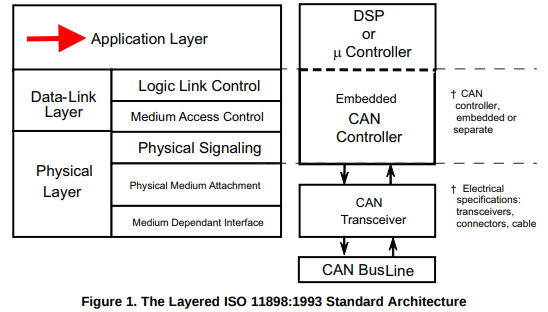
To build a CAN network, designers must also implement some higher-layer protocols. CAN (2-layer) is implemented with higher layer protocols. Several higher layer protocols already exist, including J1939 (Truck), CANopen, DSS, DeviceNet, and others. Each of these higher layer protocols, however, is an industry specific network solution. Thus, they are developed using the defined requirements for the physical layer, address structure, data structure, and application/network interface for that industry.
Here below is a copy of the CAN v2 as described by Bosch in ’91:
Do you remember when 10BASE2 “THINNET’ bus networks were popular? That’s roughly when Bosch came up with their physical layout with terminators on the end of the network. Again, not saying they are identical, but you see some similarities. I’m thinking the guys in the Bosch lab looked over at their networked workstations and RS485-connected PLCs and thought, “we could put that setup in a car, ja?” 70’s and 80’s tech still surviving…

I like to give a sincere thank you to the guys at DIY Autotune, Blink Marine, Sparkfun, UC Riverside Computer Science & Engineering, TI, and Adaptronic to name a few for as openly as possible (without being smug…) about the technology and advancing knowledge as a whole. Maybe in future posts, I could run through some topology ideas and the possible pro and cons of using CAN in a late-model vehicle.
Didn’t mean to rant about this particular topic. But, I’m picky when establishing relationships because that’s how you can enhance design, improve quality, and just be better. In the end, I do not want to push out crap or treat others like they’re dummies. Short of biz secrets, I’m sharing and more than willing to help.
Time is money. And, I hope this long read was worth your time.

 Banneker Motoring, Ltd.℠
You must be logged in to post a comment.