
Just remember the only real difference between a rocket engine and a hand grenade is the size of the explosion and the strength of the casing.
– “Beerhead“, Forum Poster
Suck, Squish, Bang, Blow…
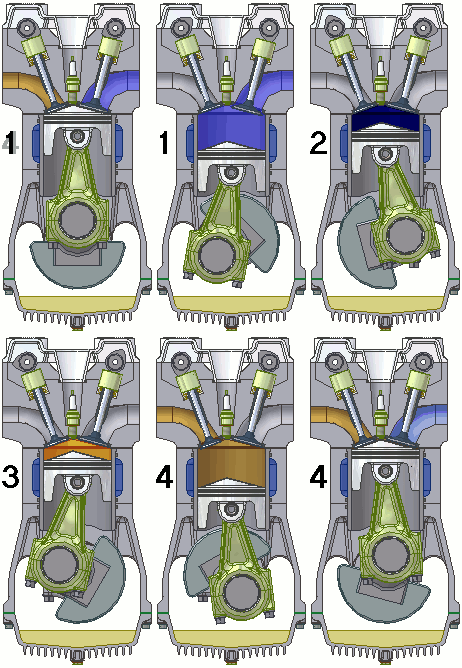
First, as a quick review, ALL internal combustion engines in some form or fashion follow this philosophy:
-
- I’m gonna take the potential energy (PE) of my fuel properly mixed with air, set it on fire, and BANG!! turning it into kinetic energy (KE) or movement.
Simple, right? Well…

Anecdotally speaking, there are teams of engineers, technicians, machinists, and craftsmen who have spent or will spend their entire careers focusing on just portions of the entire process since the 19th century. I will definitely seek out some of those ‘specialists’ along the way and hopefully, interview a couple of them.
For the upcoming posts, I will start my focus on the bottom end of the engine assembly and eventually make my way to the head.
As demonstrated in the image above of a 4-stroke internal combustion engine , 1-Suck, 2-Squish, 3-BANG!!, and 4-Blow. As mentioned in the previous post Update and Engine Choice, there will be some modifications needed to reliably meet the power band goals.
Bottom End Selection
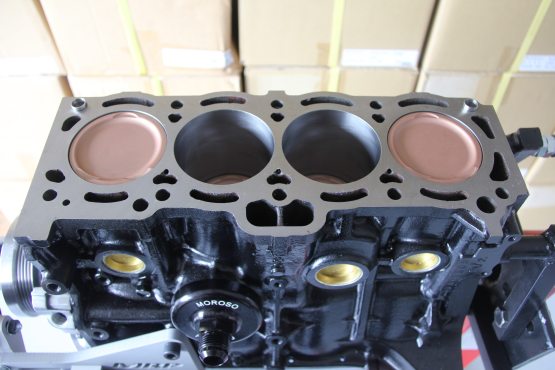
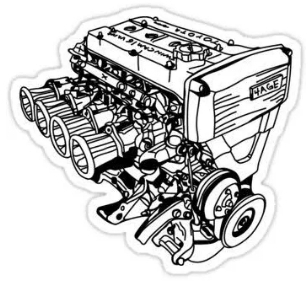
As stated, the goal is to make a broad (as possible) power band. Luckily, Toyota relied on iron blocks for a lot of their engines. The original 4AGE block is good for the most part. Mated with the Yamaha-designed cylinder head, the engine becomes a high-revving screamer. Note the trumpets (velocity stacks) on some of those performance-built 4AGE engines with ITBs. But, 4A blocks are limited by their displacement. Sure… just like any other engine you can definitely make power, but at a cost. Usually, a very high cost.
So any options? Yep, there is. In the 1990s Toyota developed for its more domesticated versions of the A engines, the 7AFE. These were produced to improve mid and low-end power in the econo-Corollas, Geo Prisms, and so forth. The 7A engine blocks are ‘almost‘ identical to the 4A, so the 4AGE heads mate up fine. Plug and Play, right? NOPE. Timing will be off and compression would be skewed higher for starters. Another issue to address is the fact the block is ‘docile’ compared to its high-revving siblings: oil journal locations, oil squirters (lack of), piston fasteners, and even cooling. A good build plan and reputable machine shop should square away the issues at hand. Still, prepping and building a 7A block is still (in my opinion and research so far) more favorable than stroking a 4AGZE block to reach the intended power goals with the emphasis on reliability and driveability .
There are countless things to look for while searching for and selection of a donor block: Are the mating surfaces square? How much maintenance (or lack of) did it get? Is there any visible damage internally and/or externally? Once the initial inspection is done,then what? Research…
In part 2, I’m going to dive into prepping the bottom end more in detail with the available options currently out there…

 Banneker Motoring, Ltd.℠
You must be logged in to post a comment.